
Business owners usually expect me to tell them they need a website. I build websites for a living. I still do not say that first. The first thing I check is whether a business has claimed its Google Business Profile, and whether what is on it is true today. Most of the time the answer is no, or it is a listing someone set up years ago and forgot.
I wanted to know if that advice still holds in 2026, with AI answering more questions before anyone clicks anything. So I went through the current research rather than repeating what everyone repeats. Here is what I found, and where the evidence is thin.
What the profile actually is now.
It stopped being a directory listing a while ago. It is the structured record Google holds about your business, and it feeds Google Search, Google Maps, and now Google’s AI answers from the same place.
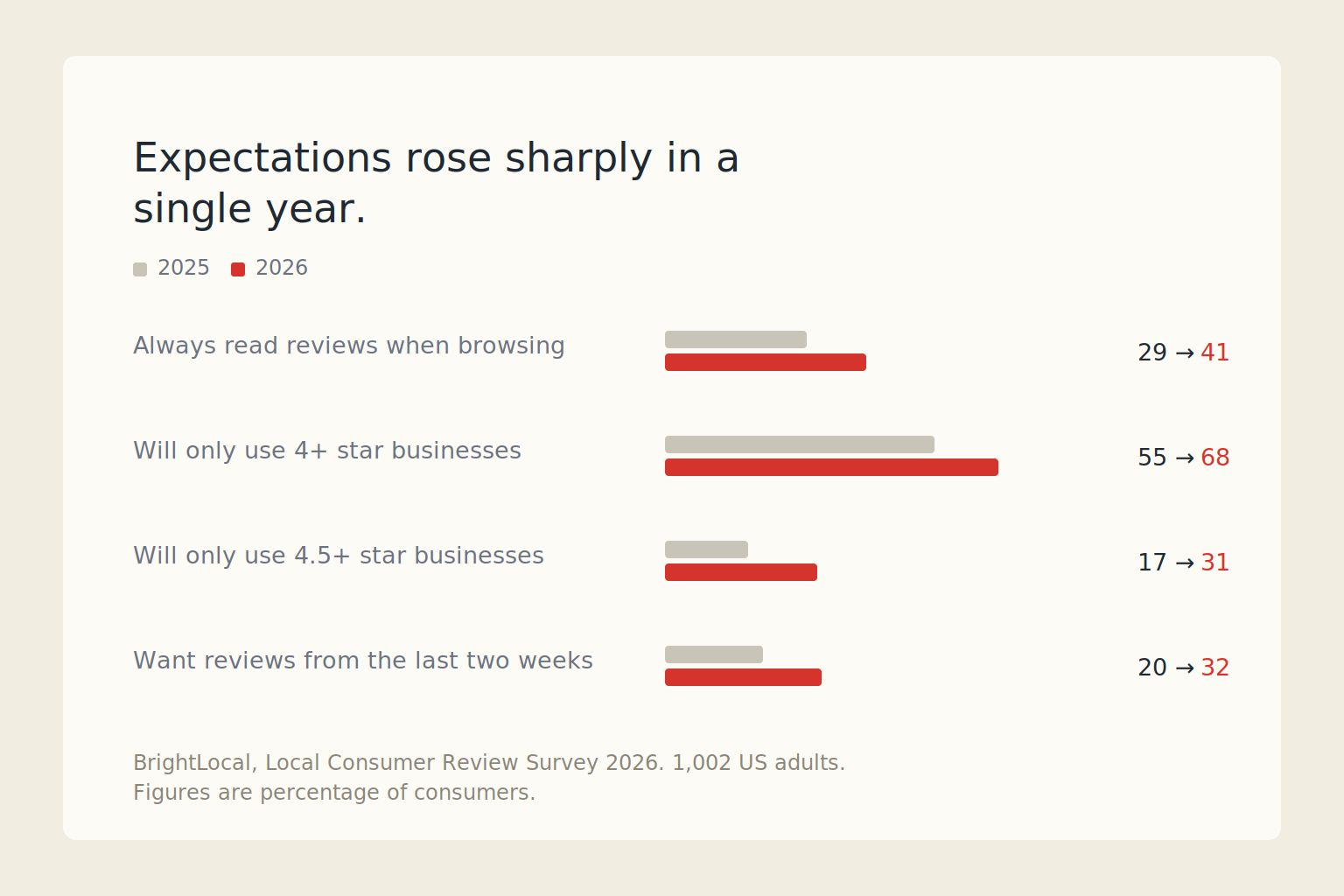
That matters because of the order people move in. In BrightLocal’s 2026 consumer survey of 1,002 US adults, 97% of consumers read reviews for local businesses, and 41% now always read them when browsing, up from 29% the year before. The same study found 54% go on to visit the business website after reading positive reviews, up sharply from 32% when the question was last asked in 2019.
Read that order again. Profile first. Website second. Building the second one first is expensive and slow. Building the first one is free.
Most businesses have not claimed it.
This is the number that surprised me most, and it is the whole argument in one line.
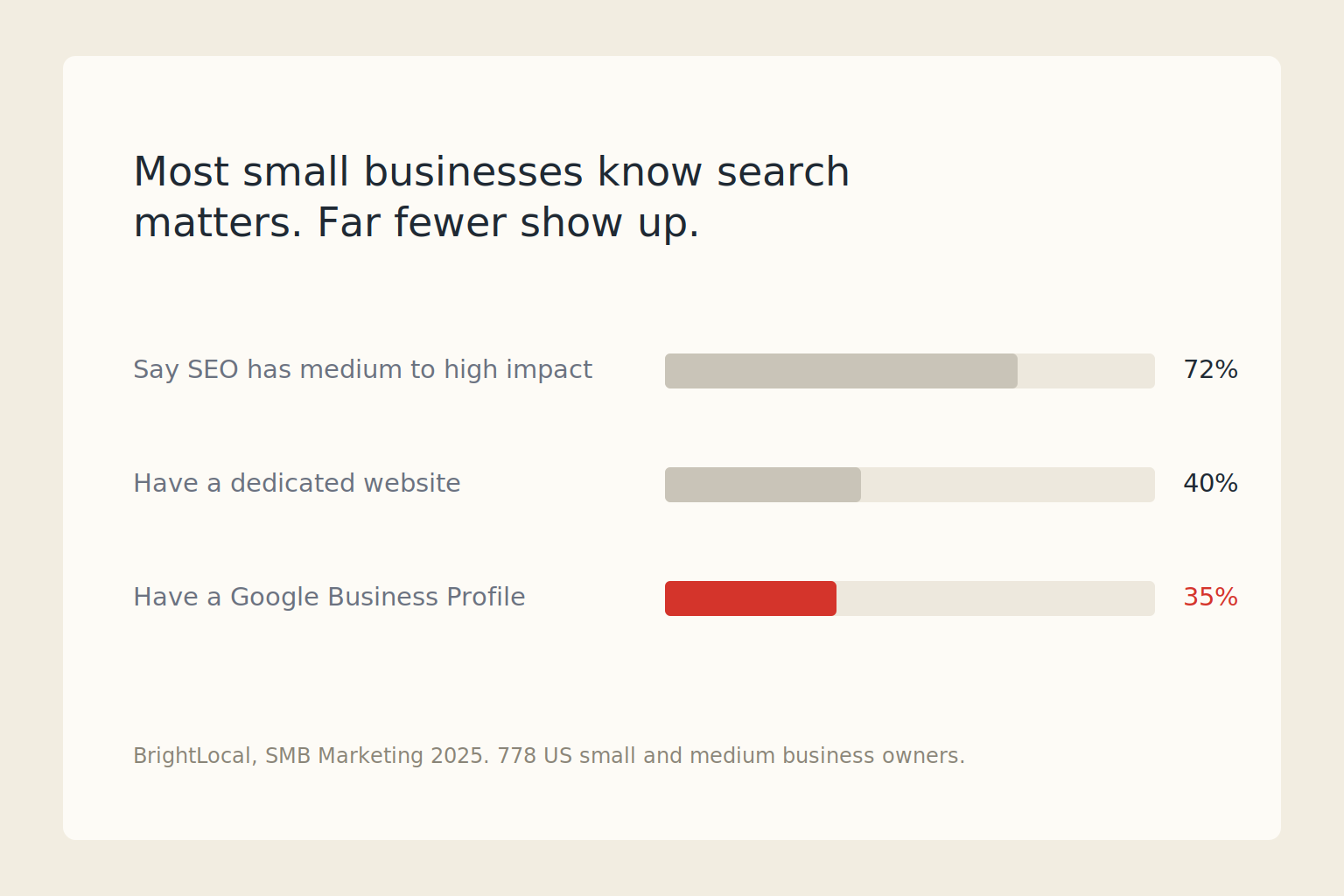
BrightLocal surveyed 778 small and medium business owners and found that only 35% of SMBs have a Google Business Profile, and just 40% have a dedicated website, even though 72% say SEO has a medium to high impact on their business.
So roughly two out of three small businesses are not on the map. Not ranking badly. Not there at all.
That is not a crisis. It is an opening. Claim the profile, fill every field, keep it current, and you are ahead of most of your local competition in week one. I cannot think of another channel where the entry cost is zero and the field is that empty.
A Google Business Profile costs nothing. Not having one is the expensive part.
What decides whether you show up.
Whitespark published its 2026 Local Search Ranking Factors report in November 2025. 47 local search experts scored 187 factors across local pack rankings, local organic rankings, conversion, and for the first time, AI search visibility. It is the closest thing the field has to a proper survey, and none of it comes from inside Google.
The top of the local pack list is almost entirely profile work:
- Primary GBP category is the number one factor, ahead of proximity to the searcher
- Business is open at the time of search ranks fifth
- High Google ratings rank sixth, quantity of reviews with text ninth, recency of reviews eleventh
- Proper placement of the map pin ranks tenth
- Completeness of the profile ranks sixteenth, correct hours twenty-first, and having your services listed twenty-second
Almost every one of those is a field you fill in for free, in an afternoon. The hours one is worth sitting with. Darren Shaw describes watching businesses sit at number one while open, start slipping about an hour before closing, and get displaced by open competitors once closed. Wrong hours are not a cosmetic error. They cost you rankings during the hours you are actually trading.
Two warnings from the same report. Keyword stuffing the profile description and AI-generated text or photos on the profile now score as negative factors with real suspension risk. Fill it in properly, in your own words.
What decides whether they pick you.
Once you are visible, reviews carry the rest, and the bar rose sharply in a single year.
From the 2026 BrightLocal survey: 47% of consumers will not use a business with fewer than 20 reviews, and only 9% will use one with five or fewer. 68% will only use a business rated four stars or higher, up from 55% the year before, and 31% now want 4.5 or higher, up from 17%. But only 10% insist on a full five stars, so you do not need perfection.
Age matters as much as score. 74% only care about reviews from the last three months, and 32% look for reviews from the last two weeks, up from 20%. A wall of five-star reviews from 2022 is doing nothing for you.
Replies are watched too. 80% say they are likely to use a business that responds to all its reviews, 42% say they are unlikely to use one that never replies, and 89% expect a response at all. Copy-paste does not count: generic or templated replies put off 50% of consumers.
And the simplest finding in the whole report: 78% of consumers were asked for a review in the last year, and 83% of those asked went on to leave one. Asking works. Most businesses just do not ask.
What decides whether they act.
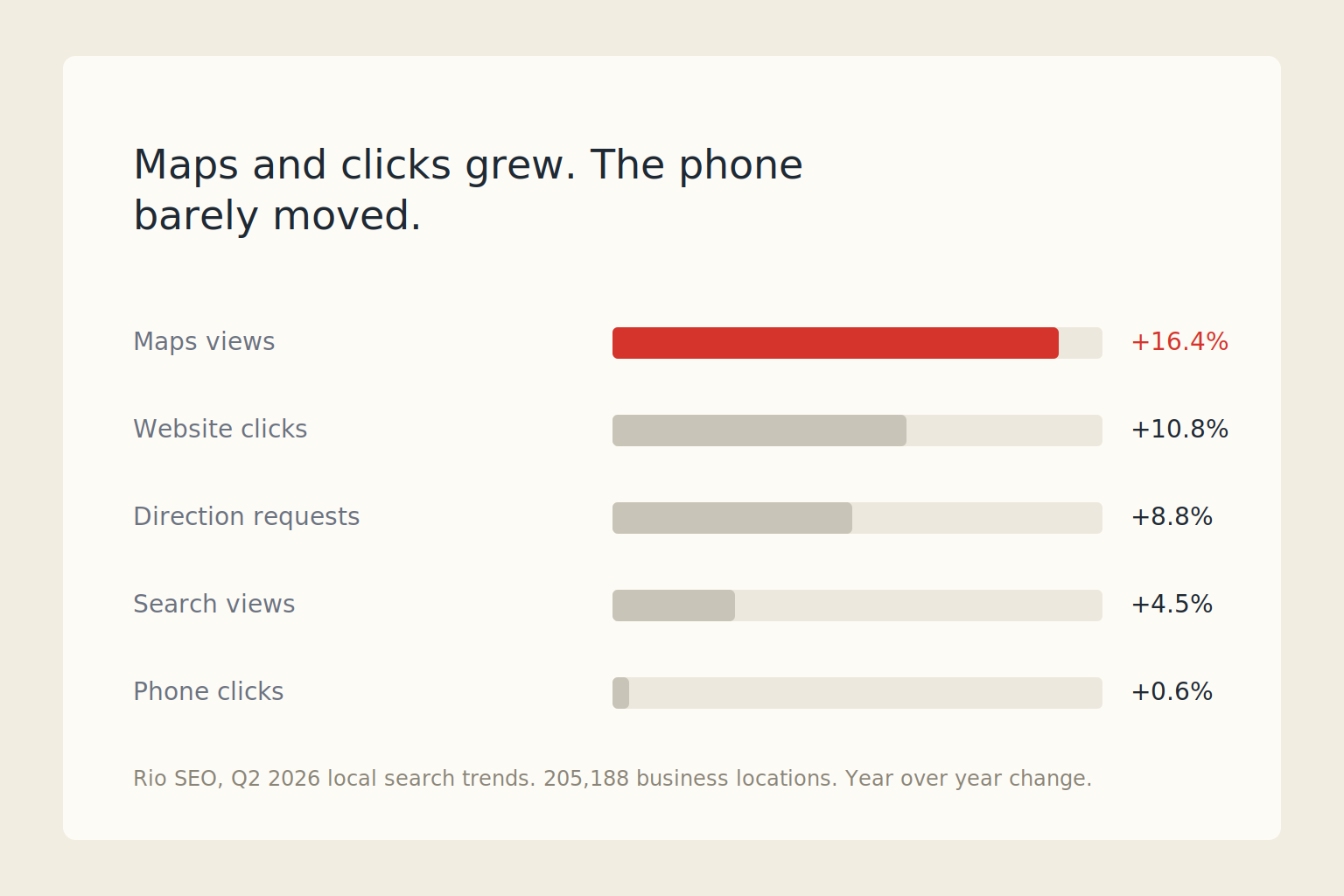
Rio SEO tracks profile performance across enterprise locations every quarter. Their Q2 2026 data covers 205,188 locations. It shows the behaviour underneath the rankings shifting.
Year over year: Maps views grew 16.4% against 4.5% for Search views. Total clicks grew faster than views. Website clicks rose 10.8% and direction requests 8.8%, while phone clicks moved 0.6%. Across the six industries they track, directions grew in every one and calls fell in four of six.
Part of that is layout, not demand. Google has been replacing call buttons with images in several industries, and its AI local packs carry no call button at all.
The practical consequence: the details on your listing now do the converting. A pin on the wrong side of the street, a stale set of hours, or a website link pointing at a generic homepage costs more than it did a year ago, because nobody complains about the shop they decided not to visit.
The AI question.
This is the part everyone is nervous about, and the honest answer is that it cuts both ways.
Use of ChatGPT and similar tools for local business recommendations jumped from 6% to 45% in a year, making AI the third most common source of recommendations. Over the same period Google’s share of review usage fell from 83% to 71%. Google’s own AI Mode passed one billion monthly users this year.
But local search has held up better than content publishing. Whitespark’s read is that discovery of local businesses is still done mostly through Google’s local results, because that is a better experience for local intent than a chatbot answer.
The more useful finding is what feeds the AI answers. Three of the top five AI search visibility factors in the 2026 report are citation factors, which is to say consistent mentions of your business across the web. Mentions are the new links. Your profile is the anchor record for all of that. Inconsistent details do not just cost you a ranking now. They produce a wrong answer in an AI response with no click for a customer to correct.
Numbers I would not use.
If you are going to make decisions on this, you should know which figures are soft.
“93% of local searches show a map pack.” This gets quoted everywhere. It has no traceable primary source, and a 540-query study across three cities and six industries found a local pack on 39% of local business searches. Plan for a pack sometimes, not always.
Google’s own numbers. The widely quoted claim that a complete profile gets seven times more clicks, 70% more visits, and is 2.7 times more likely to be seen as reputable traces back to Ipsos research commissioned by Google. The direction is almost certainly right. It is still a platform advertising its own product, and it is old.
Everything above is US data. BrightLocal surveys US consumers and US business owners. Rio SEO’s set is enterprise locations. I have not found equally rigorous India-specific research, and the India numbers circulating on marketing blogs mostly recycle the same US surveys. Treat all of it as direction, not as a forecast for your street.
Who this does not apply to.
Not every business qualifies, and it is worth knowing before you spend an afternoon on it. Google requires a business to make in-person contact with customers during its stated hours. Online-only businesses, brands, lead generation companies, and rental or for-sale properties are not eligible. If you have no location customers visit and you do not travel to them, you cannot have a profile.
If you travel to customers, you can still list, as a service area business. If you are purely online, your effort belongs in your website, your listings elsewhere, and your reviews on the platforms your buyers actually use.
What I would do in the first month.
Nothing here is clever. That is why it works.
- Claim and verify the profile. Use your real business name, not a keyword-stuffed version.
- Set the primary category carefully, then add secondary ones. It is the single highest-weighted factor.
- Fill in every field. Services, hours, service area, phone, website, description in your own words.
- Check the pin. Drag it to the actual door.
- Set holiday hours before every holiday, not after.
- Add real photos of the real place and the real work. No stock, no AI images.
- Ask your last twenty happy customers for a review. Then keep asking every week.
- Reply to every review, in your own words, within a few days.
- Point the website link at a page about that location or service, not a generic homepage.
- Check your name, address, and phone number match everywhere else you are listed.
Most businesses will read a list like that and do none of it. The ones who do it get found first, and then keep getting found, because the work compounds quietly.
We set this up for clients and then build the website behind it, in that order, because that is the order customers actually move in. If you want a second opinion on your listing, write to me at gokul@nexgu.com or reach us at nexgu.com/connect.
Sources.
None of the research here is mine. It belongs to the people below, and it is worth reading in full rather than taking my summary of it.
- Local Consumer Review Survey 2026, BrightLocal. Rosie Murphy. Representative panel of 1,002 US adults surveyed in February 2026. Source for every consumer review figure in this post.
- SMB Marketing in 2025, BrightLocal. Sammy Paget. 778 US small and medium business owners and managers. Source for the 35% and 40% adoption figures.
- Local Search Ranking Factors 2026, Whitespark. Darren Shaw, with 47 contributing local search experts scoring 187 factors. Source for every ranking factor position, the business hours observation, and the AI visibility findings.
- Local consumer search behavior trends in Q2 2026, Rio SEO. Chelsea Alves. Google Business Profile performance data across 205,188 locations. Source for the year over year action figures.
- The state of local SEO in 2026, Sterling Sky. Source for the two-year decline in clicks to call.
- Business eligibility and ownership guidelines, Google. Source for who can and cannot have a profile.
- The note that the widely quoted “93% of local searches show a map pack” figure has no traceable primary source was raised in Stethon Digital Marketing’s 2026 review of local pack statistics, which is also where the 39% figure from Whitespark’s 540-query study is cited.
BrightLocal permits use of its research findings with citation to BrightLocal as author alongside the report URL, which is what the two links above are for. Charts in this post were built by us from the published figures. If you use them, please credit the original researchers rather than us.